Researchhub bounties for peer review and replication
ResearchHub uses ResearchCoin (RSC) bounties to reward scientific contributions, including peer review, replication, data, and useful discussion. Proposal-review bounties and editor-assigned preprint grants have separate selection rules and payout schedules. Choosing a bounty starts with identifying the contribution needed and the conditions under which it earns a reward.
Peer review for proposals and preprints
Assessing a study before funding
A proposal-review bounty provides expert feedback on a planned study’s importance, rigor, and feasibility. Reviewers can choose an open proposal in their field without an invitation and submit a structured assessment following the review guidelines. Each listing identifies the proposal, reward, and submission deadline.
The public proposal-review program advertises $150 in RSC for each of the top two reviews editors accept per proposal. Payout is estimated at about 10 days after acceptance, and reviews appear publicly under the reviewer’s name. Posting a review doesn’t itself establish editorial acceptance or payment.
Acceptance for a review reward is separate from the underlying proposal’s funding eligibility. Peer reviews give funders expert context and offer authors suggestions; authors aren’t required to implement those suggestions.
Reviewing an existing preprint through a grant request
The ResearchHub Foundation’s preprint-grant guide describes an editor-assigned route for a preprint published within the previous six months and aligned with the reviewer’s expertise. The preprint must already be uploaded to ResearchHub before the reviewer submits the request form.
The guide estimates 3-4 business days for an editorial response to the request. Writing begins only after an editor approves and assigns the grant and the grant is visible on the preprint. The editorial team then evaluates the completed review and may request revisions before deciding payment.
Preprint reviews assess the research question’s clarity, methods and replicability, interpretation of results, and whether the conclusions follow from the findings. For this grant route, only the top three high-quality reviews per paper, selected by the editor, earn $150 in RSC each. The guide specifies account credit within seven days after the review window closes. Approval of the initial grant request doesn’t remove the later review-quality and selection conditions.
Replication, data, and useful discussion
Researchers also use RSC bounties to reward replication, data, and useful scientific discussion. These uses allow a request to focus on a contribution beyond a manuscript assessment. Reviewing whether methods are described well enough to repeat a study doesn’t establish that the study has been replicated.
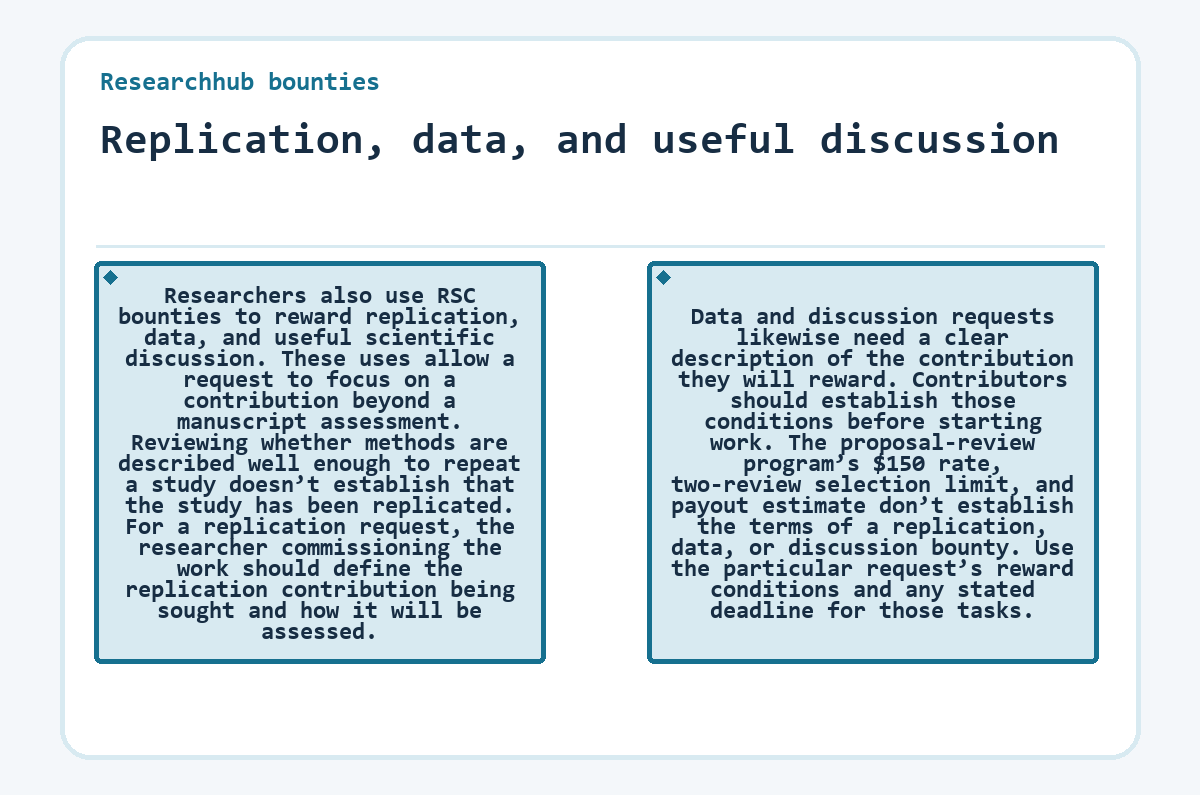
For a replication request, the researcher commissioning the work should define the replication contribution being sought and how it will be assessed. Data and discussion requests likewise need a clear description of the contribution they will reward. Contributors should establish those conditions before starting work.
The proposal-review program’s $150 rate, two-review selection limit, and payout estimate don’t establish the terms of a replication, data, or discussion bounty. Use the particular request’s reward conditions and any stated deadline for those tasks.
Interpreting the RSC reward
ResearchCoin is an ERC-20 token on Ethereum. Both review routes advertise dollar-denominated rewards paid in RSC. The preprint-grant guide specifically says the number of tokens credited depends on RSC’s value at distribution, so its $150 reward isn’t a fixed payment of 150 RSC.
The ResearchHub User Agreement effective April 21, 2026 disclaims guaranteed ResearchCoin rewards and retained value. An advertised reward, editorial selection, and an account credit describe different things; the reward description alone doesn’t establish that payment has occurred.
Review ownership and reuse
Under the ResearchHub User Agreement effective April 21, 2026, reviewers retain ownership of their peer-review content while granting ResearchHub a broad, perpetual, and irrevocable license. The license includes commercialization, sublicensing, and AI development, and it survives deletion of the review or the account. Peer-review content has separate licensing terms from the CC BY 4.0 license applied to other user content.
Bounty selection checklist
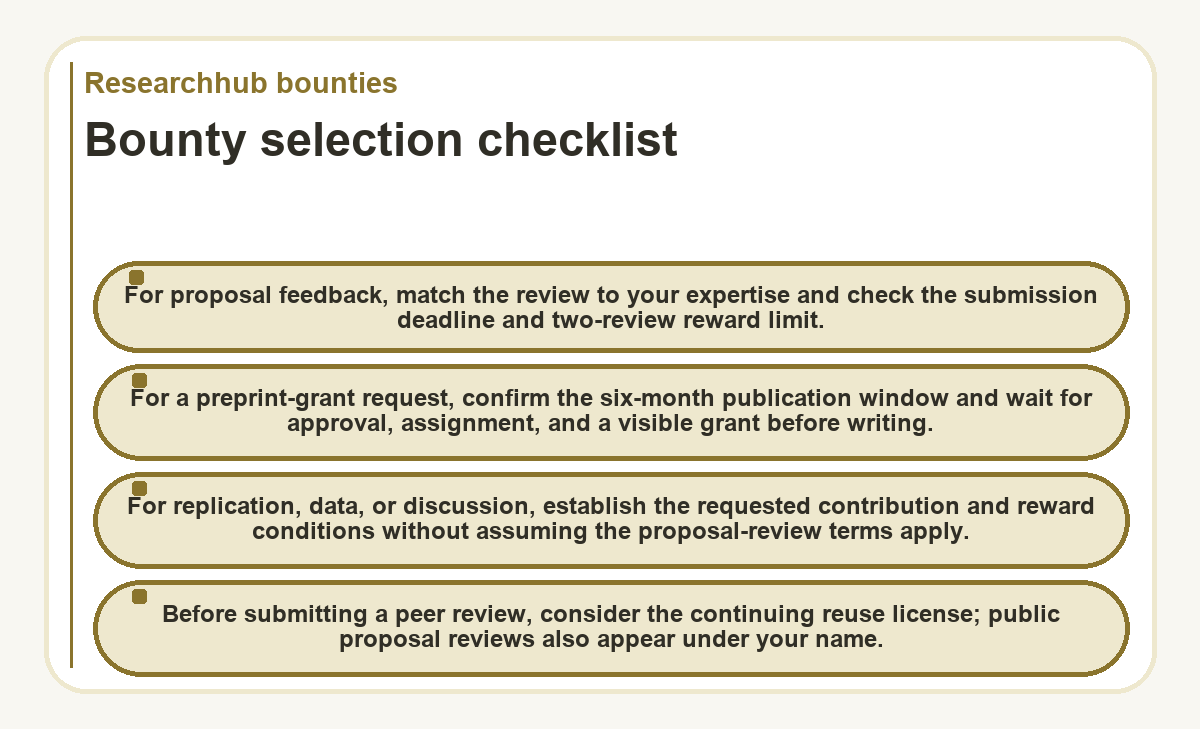
- For proposal feedback, match the review to your expertise and check the submission deadline and two-review reward limit.
- For a preprint-grant request, confirm the six-month publication window and wait for approval, assignment, and a visible grant before writing.
- For replication, data, or discussion, establish the requested contribution and reward conditions without assuming the proposal-review terms apply.
- Before submitting a peer review, consider the continuing reuse license; public proposal reviews also appear under your name.